



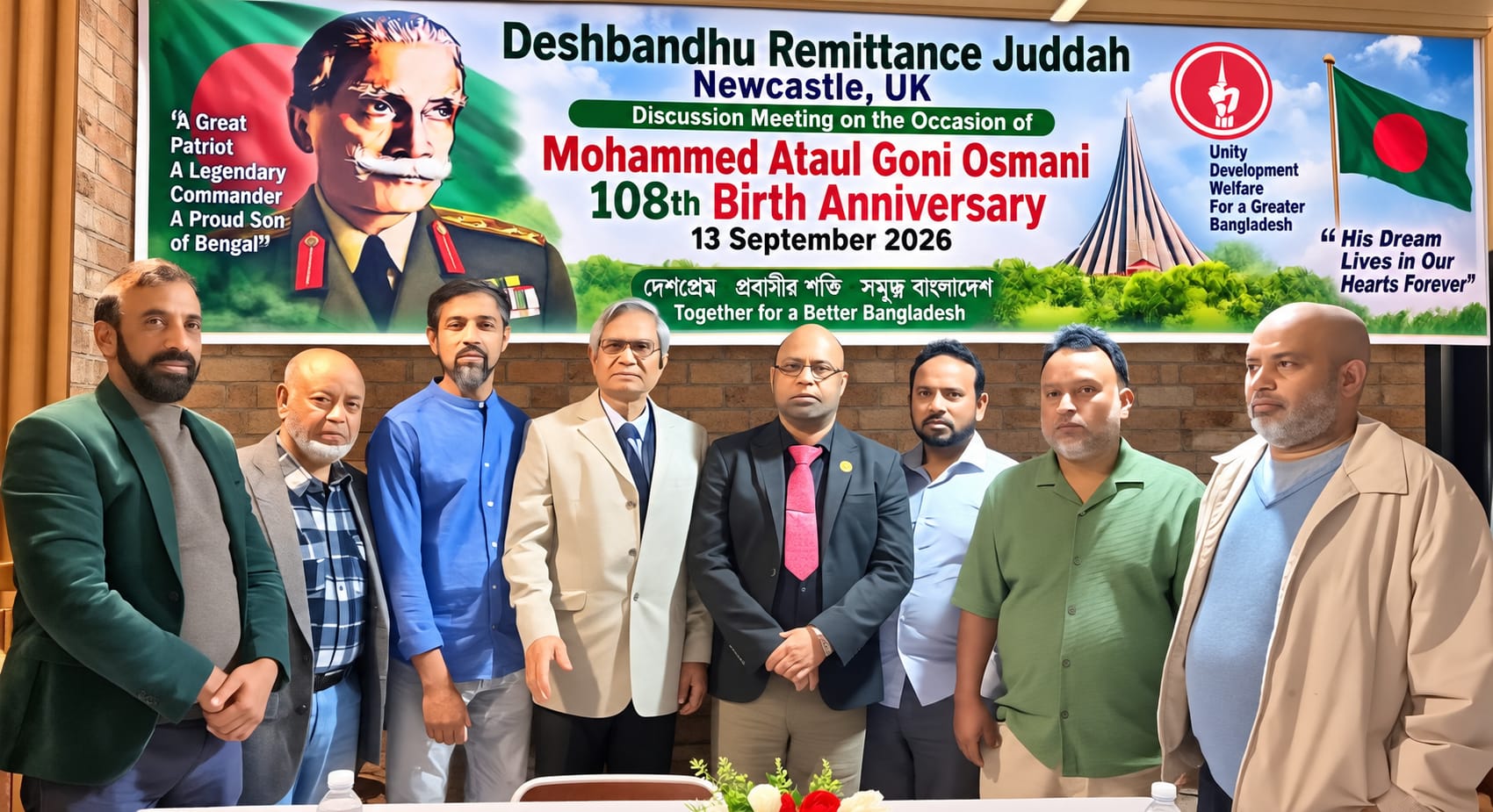
Discussion Meeting Held in Newcastle Marking the 108th Birth Anniversary of Bangabir M. A. G. Osmani
Call for State-Level Commemoration and Official Observance of His Birth and Death Anniversaries
Newcastle, UK, September 13, 2026:
A discussion meeting and exchange of views was held in Newcastle, UK, organized by the Newcastle branch of the Deshbandhu Remittance Yoddha Sangsad, to mark the 108th birth anniversary of Bangabir General Muhammad Ataul Gani (M. A. G.) Osmani, the Commander-in-Chief of Bangladesh’s glorious Liberation War.
The meeting was presided over by Md. Kaptan Mia, President of the organization’s Newcastle branch, and conducted by General Secretary Kabir Ahmed Masum. Freedom Fighter M. A. Malek Khan attended as the chief guest. Advocate A. N. M. Isa, Founder and Central Convener of the International Remittance Yoddha Sangsad, spoke as the keynote speaker. Abdul Mannan Munna, former President of North East BNP, was present as a special guest. Other speakers included M. A. Shahan Chowdhury, M. A. Munna, and Fatehul Alam Shakil.
Freedom Fighter M. A. Malek Khan
In his address as the chief guest, Freedom Fighter M. A. Malek Khan said, “We fought the Liberation War and achieved victory under the military leadership of M. A. G. Osmani. His contributions to the history of independent Bangladesh must be preserved with due state honor.”
He urged the government to consider awarding Osmani the rank of Field Marshal posthumously in recognition of his military leadership and contributions to the Liberation War. He emphasized the need to educate the new generation more extensively about Osmani’s life, leadership, patriotism, discipline, and sacrifices to ensure the history of the Liberation War is properly conveyed.
Advocate A. N. M. Isa
Speaking as the keynote speaker, Advocate A. N. M. Isa said, “It is essential to properly preserve the identity and status of M. A. G. Osmani—historically known as ‘Bangabir’—within the history of our Liberation War.”
He called upon the government and the public to raise their voices in support of upholding Osmani’s historical stature and demanded that his birth and death anniversaries be observed at the state level. He put forward several other proposals: properly presenting Osmani’s life and his military leadership during the Liberation War to the new generation; encouraging discussions and research on his contributions in schools, colleges, and universities; preserving sites associated with his memory and historical documents; organizing discussions, seminars, and commemorative events marking his birth and death anniversaries both at home and abroad; and ensuring a proper evaluation of his role in the history of the Liberation War.
Special guest Abdul Mannan Munna, former President of North East BNP, noted that M.A.G. Osmani—born on September 1, 1918, in Sunamganj—served in the British Indian Army and subsequently in the Pakistan Army. During the 1971 Liberation War of Bangladesh, he served as the Commander-in-Chief of the Mukti Bahini (Liberation Forces) and played a pivotal role in organizing and leading the military effort. After independence, he was also involved in Bangladesh’s politics and state affairs. He passed away on February 16, 1984.
In his presidential address, Md. Kaptan Mia said, “Even though we live abroad, our roots are in Bangladesh. It is our responsibility to inform the new generation about the history of Bangladesh’s independence and the figures who led the Liberation War.”
He added that observing Osmani’s birth anniversary is not merely about remembering a great individual; it is a means to pass on the ideals of the Liberation War, patriotism, and the spirit of national unity to the next generation.
Kabir Ahmed Masum
While conducting the meeting, Kabir Ahmed Masum remarked, “Conveying the true history of Bangladesh and the memory of the Liberation War to the new generation should be a vital part of our social activities abroad.”
He noted that current and future generations have much to learn from Osmani’s leadership, discipline, sense of responsibility, and commitment to the country.
M. A. Shahan Chowdhury stated, “Osmani was not just a military leader; he is an integral part of the history of Bangladesh’s independence. Further research and documentary initiatives regarding his life and work are needed.”
M. A. Munna said, “The history of the Liberation War must be presented to the new generation as national history, rising above narrow partisan politics. Osmani’s contributions are an inseparable part of that history.”
Fatehul Alam Shakil observed, “It is not enough to simply inform the new generation about the events of independence; they must also learn about the lives and ideals of those who led, struggled, and made sacrifices for that independence.” Speakers at the meeting paid deep tribute to the martyrs of the Great Liberation War, the heroic freedom fighters, and all those who sacrificed their lives for independence. At the same time, a call was made to preserve the history of the Liberation War—both at home and abroad—and to more extensively highlight the contributions of M. A. G. Osmani to the new generation.